Showing posts sorted by date for query silent film. Sort by relevance Show all posts

Saturday, March 7, 2026

Gail Patrick & O.R. Cohen in 1933 Newspaper Ads


I've mentioned in several recent posts that I've been perusing numerous issues of the Gadsden Times newspaper from the 1930s and 1940s saved by my paternal grandmother Rosa Mae Wright. She also had some old issues of the Birmingham News mixed in the batch. I'm finding lots of fascinating articles and advertisements. The two items here are ads that focus on two people with strong Alabama connections and both appeared in the News on February 16, 1933. 

I've done a number of posts on this blog about both individuals. In 2015 I wrote one of the early "film actresses from Alabama" posts about Gail Patrick. Since then I've covered a couple of her early films, "The Preview Murder Mystery" and "Murder at the Vanities" and an appearance in a radio production of "The Maltese Falcon". I also wrote about her work as Executive Producer on the classic "Perry Mason" TV series. 

Octvaus Roy Cohen [1891-1959] was a very prolific author of novels and short stories who lived in Birmingham during much of the 1920s and 1930s. He founded a group of local writers called The Loafers that included novelists Jack Bethea, James Saxon Childers and others. During those decades and beyond he published numerous short stories set in the city and featuring black characters; those stories are considered racially insensitive at best today. Cohen also published stand-alone crime novels and a series of stories about private detective Jim Hanvey. Seven of those tales were published together in 2021 in the Library of Congress' Crime Classics collection. 

I've posted twice about Cohen's books and their covers, here and here. He also had various stories and novels adapted for films. I Love You Again, a 1940 picture starring Myrna Loy and William Powell, is one of those; The Big Gamble, which happens to star Birmingham native Dorothy Sebastian is another. 

You can read more about The Loafers in John W. Bloomer's article ""'The Loafers' in Birmingham in the Twenties", Alabama Review April 1977. 

Comments on the advertisements are below. 


Patrick, a Birmingham native, graduated from Howard College [now Samford University] and completed two years at the University of Alabama law school. In 1932 she entered a Paramount Pictures contest for the "Panther Woman" character in an upcoming film, Island of Lost Souls. She was picked as one of four finalists from the 60,000 applicants. Patrick did not win, but was offered a standard studio contract. She met with studio brass and negotiated a better contract for herself. That law school training came in handy. 

The Mysterious Rider was the second of four films she made that year, playing Mary Benton Foster. The star of the film was Kent Taylor, who made some 110 movies in his career. In one of the others in 1932 she played a secretary and the other two were uncredited bit parts, the last ones she had in a career of more than 60 films made between 1932 and 1948. She did not watch herself in a film until 1979, when she finally screened one of her most famous, My Man Godfrey [1936]. 

The Galax Theater opened on 2nd Avenue North in Birmingham before 1920, showing silent films. The theater operated until at least 1945 and was torn down in 1963; the BTNB building opened on the site the following year. 


Zane Grey published more than 90 books, most of them Western novels. The Mysterious Rider appeared in 1921. 


Here's the ad for Cohen's radio mystery. Westinghouse was once a radio and television production behemoth that merged with CBS in 2000. This page has a paragraph about The Townsend Murder Mystery, radio broadcast, information about two of Cohen's detective characters in other fiction, David Carroll and Jim Hanvey, and a bibliography of Cohen's novels. 

On that page author Jon Breen says, "In an unusual and unsuccessful experiment, Cohen’s radio serial The Townsend Murder Mystery (1933) was published in book form the same year it was broadcast coast to coast (from WJZ’s New York studios) on NBC.  However it played on the air, it doesn’t work as a print mystery."


Excerpt from the listing of radio programming in the Birmingham News for February 16, 1933. KDKA is considered the first commercially licensed radio station in the United States, beginning broadcast on November 2, 1920.


This broadcast description was included in the book, which was actually the  script. 


This radio script was published in 1933 by D. Appleton-Century

A photo of Octavus Roy Cohen at Getty Images includes this original caption:
"The famous writer of Negro stories has just completed an original drama for
radio. The Townsend murder mystery, an 18 week mystery serial, begins on
February 14, on 
a coast to coast NBC network. The drama, which will require
a cast of 40 actors will be heard 
three times a week."
I've seen this work described as the "First radio play published in book form" and as the "first mystery novel to revolve around radio."


Jim Reed's wonderful Reed Books & Museum of Fond Memories in Birmingham recently had this item for sale on ABE Books: 

1933: Westinghouse Brochure Promoting Radio Show THE TOWNSEND MURDER MYSTERY By Octavus Roy Cohen (creator of Amos 'n' Andy series) with Illustration of Characters from Show Plus Photos of Westinghouse Products


Apparently Cohen did work briefly on the Amos 'n' Andy radio series but he was most certainly not the "creator". 


Wednesday, November 5, 2025

Desires, Passion and Sin!


You know, you can find some interesting stuff in the advertisements in old newspapers. Even juicy stuff. Case in point: these three ads from 1940 and 1941 issues of the Gadsden Times. My grandmother Rosa Mae Wright saved numerous front pages from that paper during World War II and others for significant events in the 1950s and 1960s. Luckily she did not detach the front page, but kept the sheet attached to it--four pages of the daily paper. Sometimes she kept more. So there are lots of advertisements.

Naturally my attention was riveted by these three ads for movie showings at the Capitol Theatre. In the June 13, 2010, issue of the Times, local historian Mike Goodson published an article about city theaters, "Gadsden Goes to the Movies". He notes that the Capitol opened June 16, 1928, and gives other details about the features and conveniences of this latest addition to the Crescent Amusement Company chain based in Nashville. The first film shown was "The Gray Vulture" with Ken Maynard, one of Hollywood's biggest western stars of the day. 

However, we will not be discussing silent western movies in this post. No, these films fall into the exploitation category. The genre has appeared under different guises throughout film history. Such movies in the 1930s through the 1950s were sensationalist but presented themselves as educational. Thus normally taboo topics could be portrayed: unwed mothers, rape, abortion and venereal diseases were common topics.

Thus we come to the specific titles here. "No Greater Sin" was making "Positively the Only City Showing" according to the February 27, 1940 ad. In this one a city health official tries to stem the spread of syphilis in his town. Dr. Edward Cavanaugh is played by Leon Ames, one of several familiar acting faces in this film. Ames' career in films and television lasted from 1931 until 1986. He appeared in well-known movies such as 1946 original version of The Postman Always Rings Twice and served a term as president of the Screen Actors Guild. Other busy character actors here include Luana Walters [numerous film roles, many uncredited], Pamela Blake [lots of western films and serials], Guy Usher [more than 190 films 1932-1943] and Tristram Coffin [films & TV roles 1930s-1970s]. These actors and hundreds of others provided supporting and background roles in Hollywood productions ranging from big budget to exploitation. 

Also on that February 27 bill was Nude Ranch, "Direct from World's Fair" and featuring "Nudies, Beauties and Cuties." In smaller print is "Visit Sally Rand's Nude Ranch". The New York City World's Fair had opened in 1939 and ran in 1940 as well. In fact, my dad and his parents went to the Fair in August 1940. Sally Rand was a famous burlesque dancer, stripper and actress who also appeared at the 1933 Chicago World's Fair. 

And you could see both of these films for only a quarter!

What Price Passion ran at the Capitol in June 1940. According to its listing in the TCM database it was released in January 1937 as Race Suicide. The cast is also made up of obscure working actors in a tale about the breaking up of an abortion racket, the "Unwarranted Maiming of Unwed Mothers." The best known name is probably Lloyd Ingraham, who in addition to his acting directed numerous silent films. This one also cost a quarter to see, and no one under 16 admitted.

The third ad promotes two films shown in August 1941. "Girls Get Up a Party" in Forbidden Desire showing with Half Way to Hell. Viewers only had to come up with twenty cents to see this pair. I've been unable to track down information on either of these titles. They might be included in Eric Schaefer's "Bold! Daring! Shocking! True!": A History of Exploitation Films, 1919-1959  ]Duke University Press, 1999]. 

Would you have expected films like these to appear in Gadsden, Alabama, in the early 1940s? 


Gadsden Times 27 February 1940


Source: Wikipedia


Gadsden Times 19 June 1940


Gadsden Times 22 August 1941

Thursday, January 4, 2024

What's Coming to the Blog in 2024?

Who knows?

For several years now I've been writing these "What's Coming" posts. You can read the 2023 post with links to earlier ones here. I include a wish list of topics I hope to cover, and look at past lists to see which ones I managed to write and which I didn't. There's more wishing than achievement in these lists, but here we are for 2024. I don't think I've written a single post from the 2023 list, so let's move on. 

I should note I'm pushing very close to 900 articles on this blog--only two or three more to go. I  started this thing in March 2014, so its tenth anniversary is also coming up. These thoughts are making me tired....

One piece I really hope to do this year is a look at the career of R.G. ArmstrongAlabama has produced at least three very prolific film & TV actors. One was Henry Walthall, a Shelby County native who appeared in dozens of silent and sound films--including the notorious The Birth of a Nation--before his death in 1936. I plan a post on him soon, too. Another was Huntsville native Harry Townes, who made numerous appearances mostly on television between the late 1940s and late 1980s. I've written about him here. R.G. Armstrong had many performances on film and television, ranging from series such as Gunsmoke, Laramie, Rawhide, Daniel Boone and The Andy Griffith Show to movies such as El Dorado, Children of the Corn and Reds. 


Armstrong appeared with fellow Alabama native Louis Fletcher in an episode of Maverick in 1959. Follow the link for my post about it. 


Armstrong made three appearances in Perry Mason episodes. This one is "The Case of the Stand-In Sister" in 1962. 

I'd also like to write a piece on Livingston Press, an independent publisher based at the University of West Alabama. Over recent decades the press has published dozens of books of fiction, non-fiction and poetry, many of them by Alabama authors. The guiding force behind the operation is Joe Taylor, an author himself and retired professor from the university.

Then there's a 1987 pamphlet in my collection about the Five Points South area in Birmingham. Fifty businesses and historical sites are listed, and I'm curious as to which ones are still around. 

I really should do an item on Louisa Shepard, the first female to receive an MD in Alabama. Since this took place before the Civil War, she was unable to establish a practice, so she married and moved to Texas. Nevertheless, she is also the first female MD in the southern U.S. and one of the earliest in the country.

Just for fun, I'd like to do another entry in the "Empty Project: Alabama" series I recently started. So much emptiness....And I'm sure there will be more blog posts on fascinating photos, postcards and family memorabilia that I come across. 


Thursday, September 21, 2023

Johnny Mack Brown as Billy the Kid

I recently picked up and flipped through my copy of William K. Everson's classic A Pictorial History of the Western Film, as one does when escaping the heat of an Alabama summer day. What did I find but a couple of stills and some discussion of Johnny Mack Brown's role as William Bonney in the 1930 film Billy the Kid. Let's investigate.


I've already written about the Dothan native, University of Alabama football star and actor in several pieces on this blog. Early in his career MGM tried to turn him into a romantic lead, such as the 1928 silent film Our Dancing Daughters in which he starred with Joan Crawford and fellow Alabama native Dorothy Sebastian. That same year major star Norma Shearer and Brown appeared in A Lady of Chance. I've devoted five posts to that film, since much of it is set in Alabama. 

In 1930 he was teamed with Crawford again in Montana Moon, which also co-starred Dorothy Sebastian. A third pairing with Crawford did not work out. Audiences failed to respond to early showings and MGM ordered the film Complete Surrender reshot with Clark Gable opposite Crawford. 

Brown soon left MGM and moved into westerns. I've posted about one of those, the 1945 "Flame of the West" in which he plays a new physician in town. Now it's time to look at another. 

Billy the Kid was one of four films Brown made in 1930 and was directed by King Vidor [1894-1982], whose career in the movies began in 1913 and lasted until 1980. The film also stars Wallace Beery as Pat Garrett, the lawman who tracked down and shot Billy on July 14, 1881. The outlaw had been sentenced to hang, escaped and killed two deputies in the process. As it happens, Garrett was born in Chambers County, so there's a second Alabama connection in this film.  

Today Henry McCarty aka William Bonney aka Billy the Kid is an iconic character with many appearances in popular culture, ranging from films and television episodes to comics and video games. But in 1930 he was just beginning his rise in the pantheon of western outlaws.

A folk song "Billy the Kid" appeared at some point in the west; the Sons of the Pioneers recorded it in 1937. A play "Billy the Kid" ran on Broadway in 1906. Two silent films about Billy were released in 1911; both starred women impersonating the male outlaw. Brown & Vidor's 1930 film was the first sound movie devoted to the Kid, and the first in which a male starred in the role!

This film was one of two released in 1930 that a used 70mm widescreen process; the other was The Big Trail starring John Wayne. Unfortunately, the Great Depression prevented cinemas from upgrading to widescreen and only a few such  movies were made at the time. The process would lie dormant until The Robe filmed in Cinemascope and released in 1953. Wayne's widescreen version has been restored, but the only known version of Brown's film is standard-width. 

Billy the Kid runs 95 minutes and was release on October 18, 1930. The film was shot on various locations such as Zion National Park, the Grand Canyon, San Fernando Valley, and Gallup, New Mexico. As the IMDB notes, the great silent film star of Westerns William S. Hart was an uncredited technical advisor. He owned some of Billy the Kid's "six shooters" and was friends with such legends of the West as Wyatt Earp and Bat Masterson. 

Images two through six below are taken from Everson's book and offer some interesting details about the film. Hart is shown in the first photo offering one of Billy's guns to Brown. The second photo is a scene with a confrontation between Garrett and Billy. In the the text shown from the book, Everson discusses the dominance of long shots and lack of closeups and the effect of that in the standard-width version. The film is available from Warner Archive; a preview can be seen on YouTube

By the mid-1930s Brown began a long series of western films for several studios, including Republic, Universal and Monogram. In the 1950s his likeness appeared in a series of comic books published by Dell. He is an inductee of the College Football Hall of Fame [1957] and the first class of the Alabama Sports Hall of Fame [1969]. He died November 14, 1974. Brown was inducted into the Hall of Great Western Performers in 2008. 


Source: YouTube 


Friday, September 15, 2023

Gail Patrick in "The Preview Murder Mystery"

One of the topics I bring out from time to time on this blog is film actresses from the state whose careers began before 1960. I've covered some others after that date, too, but today's post fits that group. 

One of those pre-1960 actresses is Birmingham native Gail Patrick. A career overview I posted in 2015 is here. In 2019 I wrote about her role as a private detective [really!] in Murder at the Vanities, a truly bonkers 1934 pre-code film. In 2020 I posted about her post-acting career as Executive Producer on the classic Perry Mason TV series and her appearance in the final episode. In 2021 I wrote about her role as the femme fatale in The Maltese Falcon--a radio version, but still....

Now we come to her role in The Preview Murder Mystery from 1936. I watched this one recently on TCM and really enjoyed it. There's a rather interesting framing device--it's a movie about the making of a movie and features quick action, witty dialog and some murders. Director Robert Florey would helm over 50 movies and numerous episodes of TV shows in his long career. By the time he made this one, he had already directed such classics as the Marx Brothers first feature, The Cocoanuts [1929] and Murders in the Rue Morgue [1932]. 

The film being filmed is "Song of the Toreador", and we get to see some extensive scenes in its preview screening. We also see even longer scenes involving the filming process, so that the cast and crew of "Toreador" are much of the cast and crew of Preview. Very meta. "Song" is a remake of a silent film starring the late husband of Patrick's character, Claire Woodward Smith. 

A lot of this film's snap, crackle and pop is courtesy of the performances by and dialog written for Reginald Denny and Frances Drake as they play the studio publicity head and his secretary. A running gag is Denny's constant proposals of marriage, and refusals by Drake, whose character is an astrology nut and keeps telling him the stars are not aligned properly.

Catch this movie if you have a chance. It's only an hour long and is available on YouTube

Some more comments are below. 


The entrance to the movie company's lot is actually the entrance to Paramount Studios, lightly disguised. 


The film has a number of shots making interesting compositions. Florey's cinematographer was Karl Struss, who worked on numerous Hollywood films and was a pioneer in 3-D. 


And here she is, ladies and gentlemen, Gail Patrick!


Now we see Patrick as she appears in "Song of the Toreador". 


And now we see Patrick in the preview audience watching herself onscreen.


As the murders mount up, Patrick is questioned by police. 


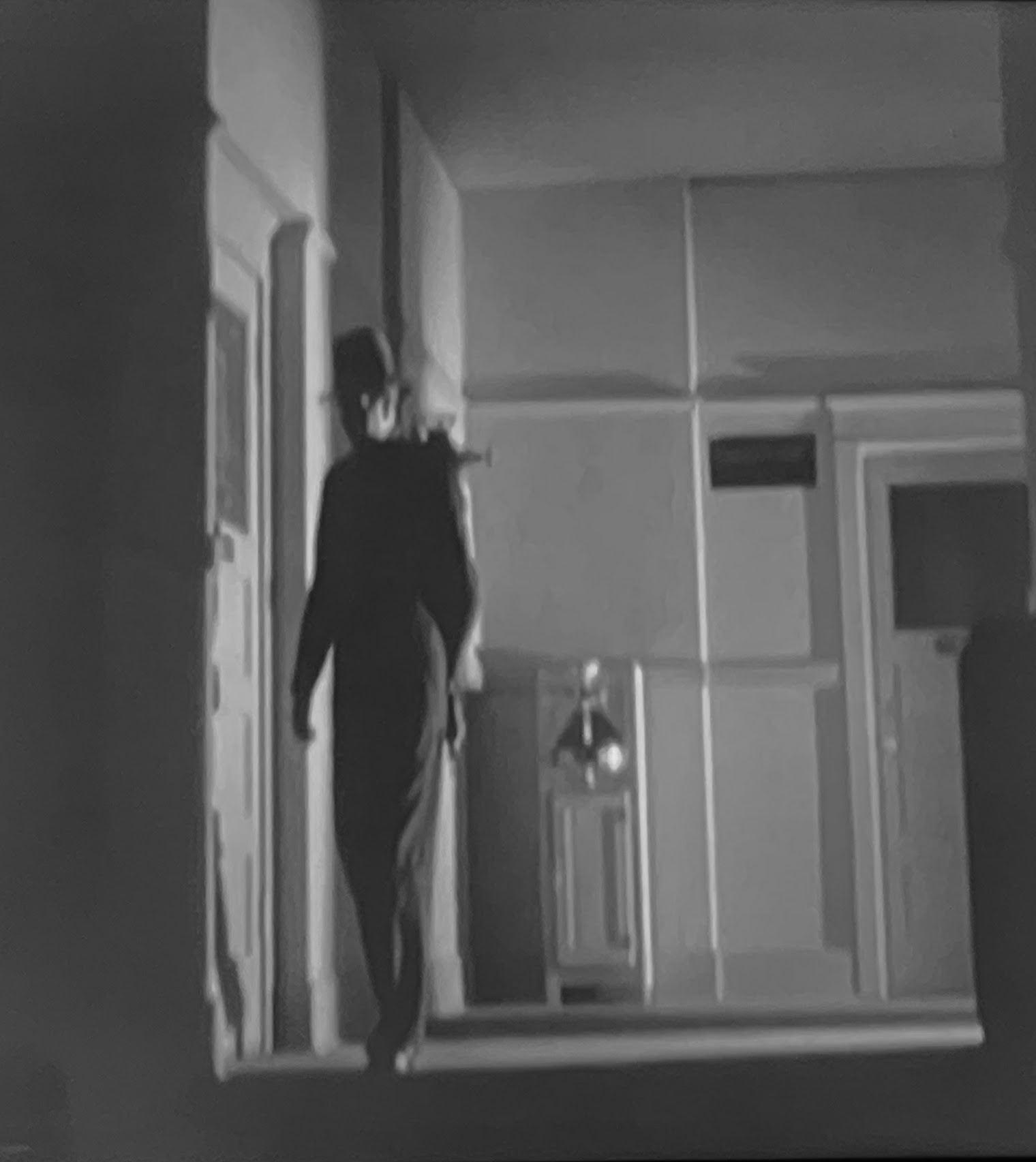
This film has a lot of shadow-and-light interplay in various scenes.


Sunday, January 1, 2023

What's Coming to the Blog in 2023?

Who knows?

Well, here I am again, at the beginning of another year and another hopeful post describing what I plan to write for this blog. What's that laughter I hear? You know the old joke, if you want to hear God laugh, tell him your plans. 

Last year's blog post, sans illustrations, is below. As usual, I didn't do so well in completing my proposed entries. No posts about Alabama's psychedelic connections [Humphry Osmond, Timothy Leary, Charles W. Slack]; Henry Walthall, the silent film star born in Shelby County; or the various state natives who appeared on the classic Perry Mason TV series. I did manage to do a post on Harry Townes, the very prolific television actor born in Huntsville who appeared on that show several times. 

I also wrote about people with Alabama connections on the Hollywood Walk of Fame. There are so many I'll have to do a second post on that topic, hopefully this year. Another subject I've wanted to explore is my collection of family ticket stubs from concerts, movies and other events that date back to the 1970s. That topic will have to be divided into several posts.

I have specific plans for a few other posts this year. These include "Roy McCardell and Birmingham", "Some Old Alabama Car Tags", "Old Ads for Alabama Bookstores" and "Anthony M. Rud's 1923 "Weird Tales" Story 'Ooze'", which is set in the state.

We'll see how all this turns out...

Now, let's do the numbers:

2022-89
2021-90
2020-108
2019-110
2018-74
2017-80
2016-99
2015-91
2014-95

A total of 836 blog posts...I'm going to rest now...


Roy McCardell [1870-after 1940]

Source: Wikipedia 


@@@@@@@@@@@@@@@@@@@@@@@@@@@@@@

What's Coming to the Blog in 2022?

You can find this post with illustrations here

For several years now I've been writing these "What's Coming" posts. You can read the 2021 post here and earlier ones here. I include a wish list of topics I hope to cover, and look at past lists to see which ones I managed to write and which I didn't. There's more wishing than achievement in these lists, but here we are for 2022. 

One of the topics mentioned last year that I'd like to finally do involves the natives or people with state connections who have stars on the Hollywood Walk of Fame. I've actually started this one; naturally, the list turned out to be pretty long. I'll probably have to split it into a couple of posts. And naturally I could follow that piece with ones on people from the state who have won Oscars, Emmys and Tony awards. Dream on.

I hope to complete four other posts in 2022 that I've been pondering for some time. Two of the most important figures in the history of LSD, Humphry Osmond and Timothy Leary, have Alabama connections--one early in his life and the other near the end of it. Henry Walthall was a major silent film star in the U.S., and his career extended into the talkie era until his death in 1936. He was a Shelby County native. Huntsville native Harry Townes became a very busy actor in Hollywood for several decades, especially on television. In 1974 he became an ordained Episcopal minister and returned to the Rocket City after retirement from acting in 1988. Speaking of Townes, I'd also like to do a post on the various state natives who appeared on the classic Perry Mason tv show. Townes acted in several episodes, as did R.G. ArmstrongLouise Fletcher and Cathy O'Donnell also turned up on the show. One day I'll also have to write a piece on all the Alabama connections on the Gunsmoke series. 

I did manage to complete two posts from last year's list. Back in the summer of 2016 I did five posts on "Beulah Vee's Cedar Chest." My dad's older sister died in 1939 just a few months after high school graduation; naturally I never met her. My grandmother Rosa Mae Wright kept a large cedar chest filled with her daughter's memorabilia. Most of those contents were donated to the Alabama Department of Archives and History in Montgomery; they form a sort of time capsule of one person's life in Gadsden, Alabama, in the 1920's and 1930's. I wrote a piece to describe that donation process and bring the story to a close.

Another topic I wanted to cover was Truman Capote and Marilyn Monroe. I had already done a pretty bogus post connecting MM and Alabama, but the one I wrote this past year was a bit stronger. You can read it here

In 2022 I'm sure I'll do new entries in ongoing series, such as films with Alabama connections, the usual crop of posts on "let's connect [fill in the blank] to Alabama!" and the usual stuff I haven't even thought of yet.

In closing, here are the number of posts I've written each year:

2021-90
2020-108
2019-110
2018-74
2017-80
2016-99
2015-91
2014-95

A total of 747 posts so far....sheesh....makes me tired just thinking about that...