Showing posts with label Tallulah Bankhead. Show all posts

Monday, January 19, 2026

Tallulah, Gary, Cary & the Devil


Film poster

Source: Wikipedia


I've written several posts on this blog about actress Tallulah Bankhead [1902-1968], a Huntsville native. These pieces include her films Lifeboat and Faithless, her visits to Birmingham and then around Alabama, her appearances on Lucille Ball's TV shows and her final acting role in a two-part episode of the 1960s Batman TV show as the villain, Black Widow. Now it's time for a look at her 1932 film Devil and the Deep, made in the same year as Faithless. 

That film is what is known as a pre-Code movie, Hollywood movies made from the late 1920s until 1934, when the Hayes censorship code went into effect. These films included subject matter ranging from abortion, prostitution and infidelity to profanity, illegal drug use and sexual situations. All of that disappeared when the Hays code was adopted. Crime and sin had to have consequences and punishment. I've written a blog post on one such very strange film featuring two Alabama connections, Murder at the Vanities [1934]. 

So, what is Tallulah up to in Devil and the Deep?  

In this film she is Diana, wife of submarine commander Charles Sturm, played by Charles Laughton in one of his earliest Hollywood films. He is pathologically jealous of every man she meets, including Lieutenant Jaeckel [Cary Grant]. Jaeckel and Diana are just friends, but no matter. As the film opens, Sturm is having him transferred, and the pair must say their goodbyes. 

Much of the film's first half takes place at a restaurant, but then Diana decides to leave and privately asks Jaeckel to come see her later in the evening. Sturm discovers them together and his anger at the dinner rises to hysteria after Jaeckel leaves, and he strikes Diana. She leaves the house immediately and begins walking the city streets.

Well, who should she encounter but the handsome Lieutenant Sempter [Gary Cooper], who is actually Jaeckel's replacement. Diana won't find that out until the next day, however, just as he doesn't know who she is. They talk themselves into a one night stand. Imagine their surprise when Sempter shows up at the house the next morning to report for duty.

Sturm's suspicion transfers to Sempter, and the commander begins to plot revenge. On the night the sub is to get underway, Diana goes aboard to warn her lover Sempter about Sturm. The commander orders the vessel to leave port with Diana still on board. Sturm has the sub deliberately maneuver into an oncoming ship and several compartments are flooded.

As survivors gather in the control room, Sturm and Sempter each assert command after Diana reveals her husband's madness. Sempter eventually takes control. In a long, exciting and apparently pretty accurate sequence, we see the crew and Diana use the escape trunk and Momsen lungs to exit to the surface. Laughing maniacally, Sturm stays behind to drown.

A court martial later clears Sempter of the most serious charges. He and Diana meet again in a store and leave together in a cab.

Devil and the Deep is based on the novel Sirenes et Tritons [1927] by Maurice Larrouy (1882-1939), a French naval officer and author of numerous novels. Marion Gering (1901-1977) directed the film, one of many he did in the 1930s. The movie is the only one in which both Cary Grant and Gary Cooper appear, although they had no scenes together. 

She made some 20 films between 1918 and 1966, yet Bankhead was best known for her stage performances in London, on Broadway and around the United States. Her best known film is probably Lifeboat [1944], an Alfred Hitchcock film that also stars another Alabama native, Mary Anderson. That movie is wonderful, Bankhead is in fine form and Hitchcock's cameo on a lifeboat in the middle of the ocean is well done.

I really enjoyed this film, just as I did another of Bankhead's films that year, Faithless. She does a good job playing the Commander's long-suffering wife, and wearing that slinky white dress through the first half of the film. The second half turns out to be an exciting series of scenes aboard the submarine and inside the escape trunk. Oh, and Laughton, Grant and Cooper are pretty good, too!

Some more comments below. 


A famous photo of Tallulah Bankhead is hanging in the Commander office. 


Early in the film Diana ponders her fate with the Commander.


Lieutenant Jaeckel and Diana converse after his transfer dinner. 


The Commander joins them at the bar.


Diana decides to leave and asks Jaeckel to come by the house later. 


And so he does. The Commander soon arrives and after Jaeckel leaves accuses Diana of infidelity and slaps her. She immediately leaves and begins a long walk. 


Well, who does she meet but Jaeckel's replacement, although neither of them reveal true identities. 


Kisses and more soon follow. 


The next morning the new lovers are in for a big surprise. 


After that the action moves quickly and the exciting submarine sequence begins. Sturm and Sempter jockey for command, and Sempter takes over. 


Let's learn how this Momsen lung thingie works. 


Sempter and Dianna have a final confab before using the escape trunk to reach the surface. 


We'll assume they lived happily ever after. 


Advertisement from The Film Daily

Source: Wikipedia


Sunday, May 11, 2025

Tallulah Bankhead Visits Alabama in 1942


I've done a few other posts on actress Tallulah Bankhead, including one on the 1944 Alfred Hitchcock film Lifeboat, in which she appeared with another Alabama native, Mary Anderson. I've also written about Tallulah and Lucille Ball, her appearance in a two-part Batman TV episode and with Robert Young in the 1932 film Faithless. I've covered her 1941 performance in Birmingham with the touring company of "The Little Foxes", which also discusses other theatrical appearances in Alabama by Bankhead. Finally, I wrote about a visit to her father William's home in Jasper, where she was married to actor John Emery on August 31, 1937. 

Now we come to her 1942 appearances in her home state, apparently in Jasper and Birmingham. In much of that year she was between two major theatrical projects. She had acted in Clifford Odet's drama "Clash by Night" in which she played a working-class housewife. Can you imagine? The play ran on Broadway from late December 1941 until early February 1942. Later in the year she opened in Thornton Wilder's "The Skin of Our Teeth" in November 1942.

During 1942 Bankhead worked on several projects to raise money for the war effort. On January 18 she made appearances urging the public to buy war bonds. On April 5 she teamed up with Danny Kaye at La Martinique in New York and for $10,000 that went to defense bonds she performed as the schoolteacher in "The Corn is Green", a role made famous by Ethel Barrymore. The evening included a  personal $5000 donation for bonds. Her 1942 appearances in Alabama may have been more fund raising.

Tallulah also did some similar work on radio in 1942. "War Bond Drive" a radio broadcast on NBC on  April 11 included Bankhead among several other stage & screen stars who read pledges from listeners. On "Listen, America" another broadcast on NBC on April 26, Bankhead read Carl Bixby's "The Roots of a Tree", which he had written for her. 

Bankhead's father had died in September 1940 and her trips back to Alabama seem to have gotten fewer after those in 1941 and 1942. She had many relatives around Jasper, but her outrageous behavior over the years had scandalized them and other conversative residents of the state. However, when she did return Tallulah drew crowds!

There's another interesting item from 1942 involving both Bankhead and fellow Alabama native Joe Louis. That spring she declared Louis to be the "greatest man in the United States" after Franklin D. Roosevelt. Her comments attracted significant press coverage; you can read one of the articles below. 

All photos below were taken by Ed Jones of the  Birmingham News


Tallulah visits with some ladies.


Tallulah speaks at the American Legion post in Jasper. Sitting beside her is Marie Bankhead Owen [1869-1958], author and director of the state archives for 35 years. She was Tallulah's aunt. 


Bankhead salutes the flag at the American Legion in Jasper.


A parade for Bankhead in Jasper


A smiling Tallulah and her dog at the original Tutwiler Hotel in Birmingham


Tallulah and a military officer


May 28, 1942

Source: 
Library of Congress collection
Chronicling America


Friday, March 13, 2020

Miss Tallulah Bankhead as "Black Widow" (2)

This post is the second one in which I examine Tallulah Bankhead's appearances in two episodes of the 1960's television show Batman. You can read my opening commentary and the details of the first episode here


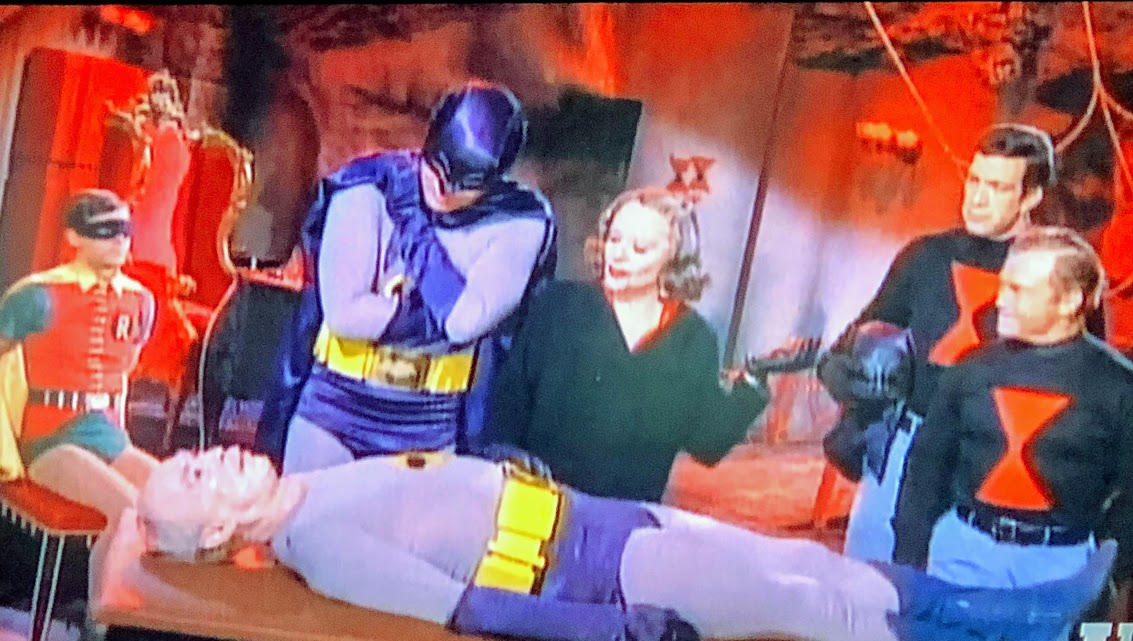
Batman and Robin manage to escape the giant spiders, but they still must face the Black Widow and her merry men.


Ever the polite hostess, BW offers Batman some champagne. 


Batman quickly informs her he only drinks milk, and she replies that there may be some around somewhere. 


One of her men, Trap Door, produces a half gallon carton.


Black Widow manages to drink some milk, but she's not happy about it 


During their little tete-a-tete over milk, Bankhead gets to unleash her raucous laughter.


Black Widow's next nefarious plot is to send a Batman robot and the real Robin to fetch some money from another bank. 


BW and her men are very happy with the idea, but the joy doesn't last long. 


The Chief of Police Miles O'Hara and some of his men show up to capture the gang.


When next we see BW and her men, they are undergoing some brain therapy in jail.


Black Widow emerges very happy with the results, and all is well in Gotham City until next week's villain shows up!


Wednesday, March 11, 2020

Miss Tallulah Bankhead as "Black Widow" (1)

The live action Batman TV series ran for 120 episodes in the swinging sixties, from January 12, 1966 until March 14, 1968. The campy take on the legendary character was so popular ABC broadcast episodes two nights a week during the first two seasons. The series also spawned the first full-length feature film with Batman, released in 1966. 

A prominent aspect of the show featured recurring villains played by well-known actors of the day who joined in the fun. Cesar Romero played The Joker, Burgess Meredith The Penguin and Frank Gorshin and John Astin both played The Riddler. Julie Newmar and Eartha Kitt starred as Catwoman. Less well-known villains were acted by George Sanders, Vincent Price, Cliff Robertson, Milton Berle, Anne Baxter and Carolyn Jones among others.

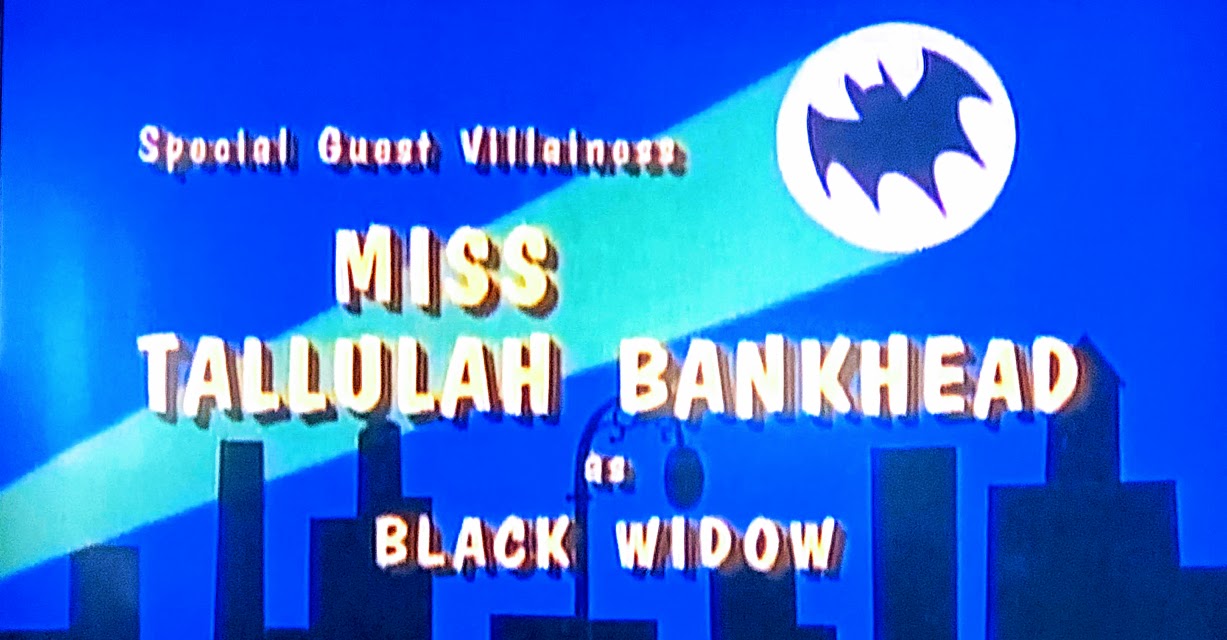
Alabama's own Tallulah Bankhead appeared in two episodes in season two, "Black Widow Strikes Again" on March 15, 1967, and "Caught in the Spider's Den" the following night. I've done several blog posts on Bankhead and will no doubt do others in the future. I wrote about her 1932 film with Robert Montgomery, Faithless and her 1944 film Lifeboat. She made two appearances, sort of, on Lucille Ball comedy shows. I've also written about a 2018 visit to the Jasper home of her father, William Bankhead. You can find my brief biography of her in that Lucille Ball post.

Well, just how did Miss Tallulah Bankhead get on this show, anyway? Joel Lobenthal in his 2004 biography Tallulah!: The Life and Times of a Leading Lady tells the tale. One of her lifelong friends was actress Estelle Winwood, and she told Tallulah what a good time she'd had during her appearances. Bankhead made a late night call to executive producer William Dozier  and told him she "must" be on the program. Production staff member Robert Mintz wrote two scripts about a new villain created just for her. The Black Widow had taken up a life of crime after the death of her husband, Max Black. In the show her partners call her "Blackie" or "BW". Batman declares she is "sophisticated but evil."

By the time these episodes were broadcast, Tallulah was less than two years away from her death on December 12, 1968. Her health problems had limited her acting in the 1960's. Her last appearance on Broadway came in a revised version of Tennessee Williams' The Milk Train Doesn't Stop Here Anymore which ran briefly in January 1964. Williams' had written the play for her and loosely based the character Flora Goforth on her. 

Bankhead made her last trip to Hollywood from her home in New York City in December 1967 to appear on the Smothers Brothers Comedy Hour. She appeared on The Tonight Show with Johnny Carson one final time on May 14, 1968. Joe Garagiola was guest hosting; John Lennon and Paul McCartney, and pie-in-the face comedian Soupy Sales were also guests.

I recently watched these two Batman episodes, and in this blog post and a second one I'll be discussing them. See further comments below. The show certainly wasn't high art, but these episodes with Bankhead were fun to watch.

Alabama has had at least two other "spider" women, Carol Foreman & Marie Hilley. Alabama native and actress Forman played the lead in The Black Widow, a 1947 film serial from Republic Studios. Hilley was a real-life Alabama serial killer often called "The Black Widow". 


As our story opens, Black Widow arrives at a bank in the sidecar of a motorcycle driven by one of her underlings. 


In the bank president's office she turns on the charm. 


Black Widow used hypnosis, drugs, and other methods to control victims. In this first episode she uses a machine to short-circuit brain waves and make the victim obey her commands. 


Soon she is leaving the bank with a big bag of money.


In her lair, the Black Widow and her henchmen admire the money.


Soon she is arriving at another bank. Here, before she can take possession of the money, Batman and Robin show up. Police Commissioner Gordon has asked for thei help in catching her.


Blackie whips out another of her weapons, the Instant Nerve Paralyzer ad zaps Batman with it. She doesn't even bother with little Robin. 


With Batman under control, the Black Widow can toy with Robin.


Black Widow and her driver return to the lair, which is underneath a suburban home. 


On her periscope she watches the arrival of Batman and Robin after the nerve paralyzer has worn off. 


Black Widow soon has the Dynamic Duo in her web, literally, and questions arise when she unleashes her real giant spiders.


Well, as they say, "Tune in tomorrow night...."


These are the actors who played Black Widow's partners in crime. Donald Barry acted in a number of western TV shows as well as other programs and films. Al Ferrara has only a few credits in the IMDB in addition to these episodes. Michael Lane had a number of roles in films and television between 1956 and 1994 including Hondo, Gunsmoke, Kojak, and Mission Impossible. 


Actor George Raft makes a brief, uncredited appearance near the end of this episode. In November 1933 Bankhead had a five-hour radical hysterectomy at a Los Angeles Hospital. The operation, which almost killed her, was done to treat an advanced case of gonorrhea. According to Lobenthal's biography, she later told a confidante that Raft had given the disease to her. The two actors don't have a scene together, but the juxtaposition seems odd. Were such uncredited appearances common on the show, or did Tallulah have something to do with it in this episode?